
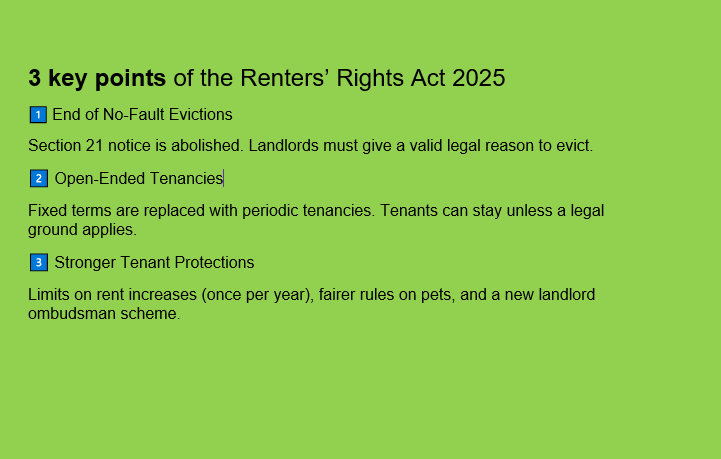
In a landmark shift for England’s private rental sector, the government is abolishing Section 21 notices — the legal basis for “no-fault” evictions that have allowed landlords to regain possession of their property without giving a reason. This change will take effect from 1 May 2026 under the recently passed Renters’ Rights Act 2025.
For decades, Section 21 has been a tool landlords could use to end tenancies — simply by serving notice with no explanation. Tenants often lived in fear of being asked to leave with just two months’ notice, and in practice that fear contributed to housing instability and even homelessness for many families.
What’s Changing on 1 May 2026
From this spring:
-
No more new Section 21 notices. Landlords will no longer be able to evict tenants without giving a legally recognised reason.
-
Tenancies become open-ended. The familiar Assured Shorthold Tenancy (AST) model — with fixed terms and an easy exit for landlords via S21 — is being replaced by periodic tenancies.
-
Possession claims must use Section 8 grounds. Landlords must rely on specific reasons, now expanded and updated, such as tenant breaches, serious rent arrears, or the landlord’s need to sell or move into the property. This means that the tenant must owe at least two months’ rent (if rent is monthly). The arrears must be at or above this level on the day the Section 8 notice is served AND on the day of the court hearing. If arrears drop below the threshold at the hearing, Ground 8 fails.
These changes were introduced to give renters more security and confidence that their homes will not be lost without cause. But while well-intentioned, the reforms are already reshaping the private rented landscape in ways that go beyond tenants’ rights alone.
The Property Supply Crunch: Less for Councils and Families in Need
One of the unintended consequences of abolishing no-fault evictions is a drop in the willingness of landlords to let properties for use as temporary accommodation.
Local councils across England routinely rely on private rented sector (PRS) landlords to provide homes for families who are homeless or at risk, particularly for temporary accommodation while permanent housing is secured. But with Section 21 protections ending, many landlords have become hesitant to offer properties for several reasons:
1. Loss of a Clear Exit Mechanism
Without the option to regain possession via Section 21, landlords are now more cautious about entering into lettings where they might later need to recover their property — especially for reasons like selling the property or changing personal circumstances.
2. Concerns About Future Flexibility
Since tenants now have much stronger security of tenure and landlords must rely on evidence-based reasons to repossess, some landlords feel “locked in” to tenancies. This has prompted a number to rethink whether they even want to keep certain properties in the long-term rental market.
3. Reduced Incentive to Supply to Councils
For councils seeking to use private properties as temporary accommodation, this has had a negative impact on stock availability. Where landlords once saw council contracts as a viable way to ensure stable rental income, the new legal landscape has dampened enthusiasm — particularly among smaller private owners who fear difficulty regaining control if they need the property back. Local discussions and industry analysis suggest that fewer landlords are now supplying properties to councils for use as temporary accommodation. This reduction compounds existing shortages in social housing and contributes to longer stays in unsuitable or interim housing for vulnerable families.
What This Means for Families and Communities
The practical effects on families already facing housing insecurity can be stark:
-
Fewer homes available when they need them most — for temporary accommodation or immediate re-housing.
-
Longer waits in difficult living conditions due to the shrinking pool of council-sourced rented properties.
-
Increased pressure on local authorities, who face rising costs for their own provision and statutory duties to house those in need.
National news coverage highlights the broader challenges councils are already facing with temporary accommodation budgets ballooning and symbolic targets unmet.
A Balancing Act: Rights vs. Realities
There’s no doubt that ending no-fault evictions is a historic step forward for renters. The reforms aim to reduce insecurity and unfair practices in the rental market. But they also intersect with existing housing shortages, tight council budgets, court backlogs, and a rental market still strained by high demand and low supply.
Understanding these changes — both the legal progress and the practical challenges — is crucial for renters, landlords, and policymakers alike. Only by acknowledging both sides of the story can we work toward solutions that keep families housed, protect fair rights, and maintain a sustainable rental market for all.
What Is Section 21?
Section 21 notice allowed landlords in England to evict tenants without giving a reason, provided they followed the correct notice procedure. This meant a tenant could be asked to leave even if they had paid rent on time and complied with their tenancy agreement.
Under the new reforms introduced through the Renters’ Rights Act 2025, Section 21 will be abolished. Landlords will instead need to rely on specific legal grounds under Section 8 if they wish to regain possession of their property.
Before and After: What Changes for Tenants?
Below is a simple comparison to help current tenants understand how the system is changing.
| Area | Before (With Section 21) | After (Post-Reform) |
|---|---|---|
| Eviction without reason | Landlords could issue a Section 21 notice without giving any reason. | No more no-fault evictions. Landlords must give a legally valid reason. |
| Security of tenure | Tenants often had 6–12 month fixed terms and could be asked to leave after this period. | Tenancies become periodic (open-ended). Tenants can stay unless a legal ground applies. |
| Landlord selling property | Often used Section 21 to regain possession quickly. | Must use a specific legal ground for sale under Section 8 rules. |
| Rent arrears cases | Section 8 used, but Section 21 was sometimes used as backup. | All possession cases must rely on defined legal grounds. |
| Tenant confidence | Many tenants felt insecure and hesitant to complain about repairs. | Greater protection from retaliatory eviction. |
| Notice period | Typically 2 months under Section 21. | Notice periods vary depending on the legal ground used. |
The Unintended Consequences: Reduced Property Supply
While the reforms are positive for tenant security, they have also influenced landlord behaviour.
Many landlords, concerned about losing flexibility and facing longer court processes, have:
- Sold properties before the legislation is implemented
- Issued Section 21 notices prior to the deadline
- Withdrawn from supplying properties to local councils
This has had a measurable impact on the availability of homes for temporary accommodation.
Fewer Properties for Councils
Local authorities rely heavily on private landlords to provide homes for families who are homeless or at risk of homelessness. These properties are often used as temporary accommodation while longer-term housing is arranged.
However, with Section 21 being removed:
- Some landlords feel they may struggle to regain possession if needed.
- Smaller landlords in particular are exiting the temporary accommodation market.
- Councils report increasing difficulty sourcing private rented properties.
The result?
Families requiring emergency housing are facing:
- Longer waits for suitable accommodation
- Increased use of hotels and short-term placements
- Greater instability during already stressful circumstances
Landlords Acting Before Implementation
Another significant trend has been landlords serving Section 21 notices ahead of the new rules taking effect. In some cases, tenants have been asked to leave not because of rent arrears or breach — but because landlords wish to avoid being tied into the new framework.
This has contributed to a short-term rise in evictions before implementation, placing additional strain on families and local housing services.
A Delicate Balance
The abolition of Section 21 is designed to:
- Improve tenant stability
- Prevent unfair evictions
- Encourage longer-term renting security
But reform in a housing market already experiencing supply shortages is complex. When landlords reduce stock — particularly from council-linked temporary accommodation schemes — the impact is felt most acutely by vulnerable families.
What Should Tenants Do Now?
If you are currently renting:
- Check your tenancy type.
- Seek advice immediately if you receive notice.
- Speak to your local authority early if you are at risk of homelessness.
- Understand that once reforms are fully implemented, your rights will strengthen.